Residential installation
New Furnace Installation in Fort Wayne, IN
What actually happens between the phone call and the moment your new furnace runs for the first time — written for homeowners who want to know what they're buying.
For service availability, please have your 5-digit ZIP code ready.
Most furnace installations in Fort Wayne are replacements: an existing forced-air system is already in place, and the job is to remove equipment that has reached the end of its life and install a properly sized replacement that vents safely and works with the duct system the house already has. That last part is where installation quality separates itself, and it's largely invisible once the panels are back on.
This page walks through the work in the order it happens, including the parts that homeowners rarely get shown.
1. The evaluation, not the guess
A furnace installation starts with looking at the house. That means the existing equipment's nameplate and condition, the venting path and what else shares it, the gas supply and meter capacity, the electrical circuit, the supply plenum and return air, the filter arrangement, the clearances around the equipment, and the physical route the old cabinet has to travel to get out of the building.
It also means asking about comfort. If a bedroom has never been warm enough, that's information about airflow that belongs in the installation plan — not a complaint to rediscover after the new furnace is running.
2. Sizing the replacement
Sizing determines whether your new furnace runs in long, steady cycles or short bursts. Heating load depends on insulation levels, window area and type, air leakage, orientation, ceiling height, whether the basement is finished, and any additions. Manual J is the established residential load-calculation methodology, and it exists precisely because floor area alone is a poor predictor.
Pay attention to the difference between BTU input and BTU output. A 100,000 BTU input furnace at 80% AFUE delivers about 80,000 BTU of heat; the same input at 96% delivers about 96,000. If you compare two quotes on input alone, you may be comparing different amounts of heat. More on this in our furnace sizing guide.
3. Choosing equipment
Three decisions drive most of the equipment cost: efficiency level (roughly 80% AFUE non-condensing versus 90–98% condensing), staging (single-stage, two-stage, or variable / modulating), and blower type. Higher staging and variable-speed blowers generally produce more even temperatures and quieter operation, and they cost more up front.
Read the warranty terms before you choose. Heat exchanger coverage, parts coverage, labor coverage and registration deadlines vary by manufacturer and model, and a shorter registration window can quietly change what you actually own. See our high-efficiency replacement page for how the condensing decision affects the installation itself.
4. Permits, where applicable
Residential furnace replacement generally requires the applicable HVAC/mechanical permit through the Allen County Building Department (200 E Berry St, Suite 180, Fort Wayne, IN 46802) for Allen County addresses. Requirements can vary with the scope of work, so confirm current requirements for your project. Outside Allen County, permitting goes through the authority having jurisdiction for the address.
5. Removal of the existing furnace
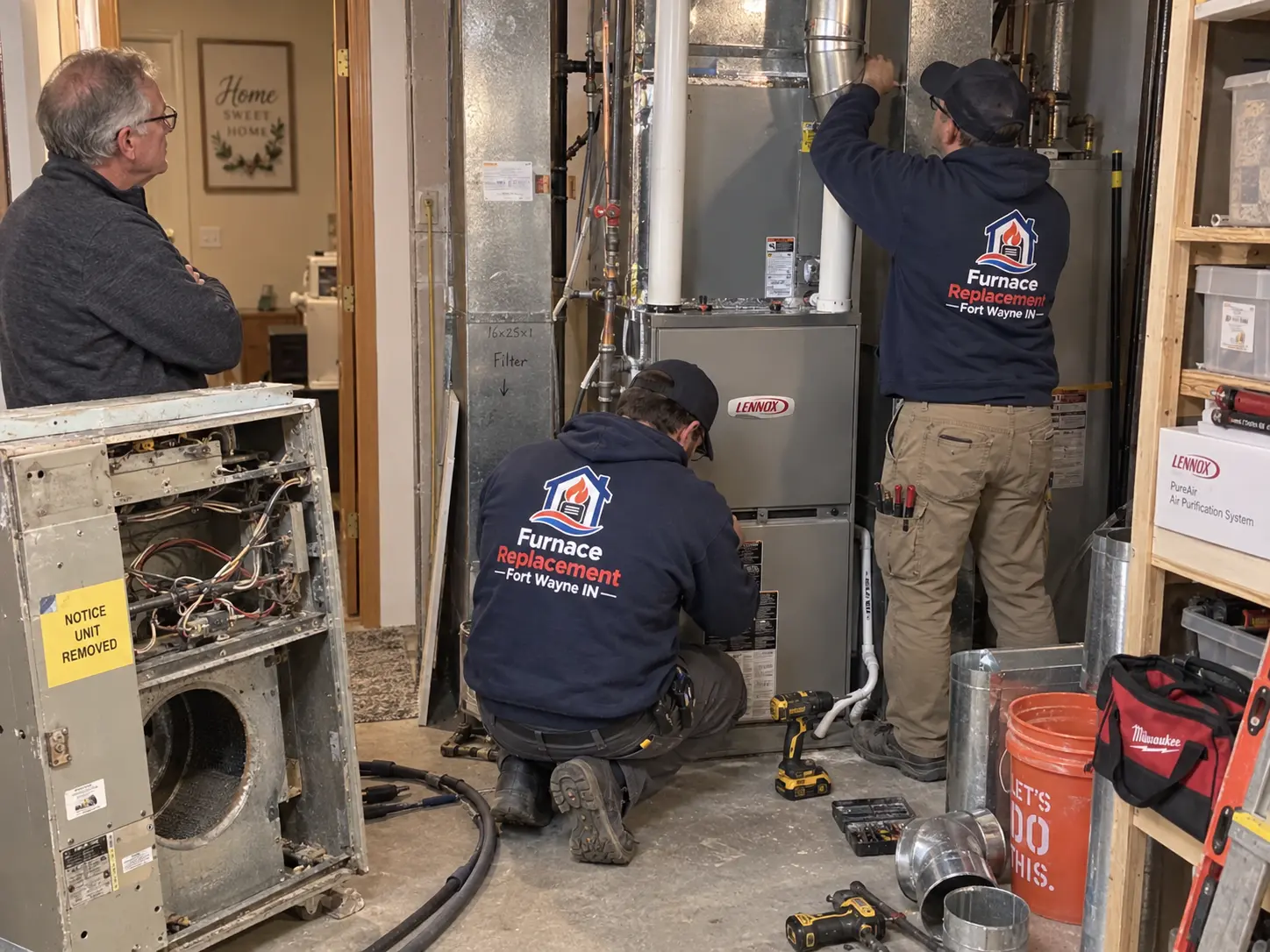
Gas is shut off and the line disconnected, electrical is disconnected at the disconnect or panel, the flue or vent is separated, and the cabinet is cut free of the plenum and return drop. Older units can be heavy and awkward, and tight basements or crawlspaces make this the slowest part of some jobs. Removal and disposal of the old furnace should be stated in the written scope.
6. Setting and connecting the new furnace
The new cabinet is positioned, leveled and secured, then tied into the supply plenum and return air. Because cabinet widths and heights rarely match exactly, sheet-metal transitions are normal work — and doing them properly matters more than most homeowners realize. A sloppy transition creates turbulence, noise and airflow restriction that the equipment then fights for twenty years.
Connections then follow: gas piping with a drip leg and shutoff, electrical, condensate drainage on condensing equipment, thermostat wiring, and venting.
7. Venting
An 80% AFUE furnace vents through a metal flue, frequently into an existing chimney. A condensing furnace vents through PVC to an approved sidewall or roof termination and takes combustion air the same way. If your home currently vents into a chimney and you choose condensing equipment, new venting plus a condensate path is added work that belongs on the quote as a line item.
One detail deserves special attention: if a water heater shares the chimney with the old furnace, removing the furnace changes how that flue behaves. That situation needs to be evaluated, not ignored.
8. Startup, safety checks and documentation
A furnace installation isn't finished when the burners light. Startup should include verifying ignition sequence and staging, measuring temperature rise against the manufacturer's range, confirming static pressure or airflow is reasonable, checking gas pressure, verifying vent performance, testing safety controls, and confirming thermostat operation in heating and fan modes.
9. Homeowner walkthrough
Before the crew leaves, you should know where the filter is and what size it takes, how to operate the thermostat, where the gas shutoff and electrical disconnect are, what normal operation sounds like, and what your warranty requires of you. Ask for the model and serial numbers in writing.
How long does it take?
Many straightforward replacements can often be completed within a working day. Venting conversions, significant duct modifications, difficult access, or conditions discovered during removal can extend the project. For a realistic timeline, see how long furnace replacement takes.
What installation costs
Many 2026 Fort Wayne planning estimates fall roughly in the $4,000–$7,500 range for a straightforward furnace-only replacement, while high-efficiency or complex installations can fall outside that range. That's a planning estimate, not a quote. Our cost page breaks down each factor, and the cost calculator produces a range based on your specific answers.
Installation FAQs
Is a new furnace installation different from a furnace replacement?
Do I need to be home during the installation?
What should I do to prepare?
Will the installers test the system before leaving?
Related pages
Ready to Plan Your Furnace Installation?
24/7 service availability.
For service availability, please have your 5-digit ZIP code ready.